
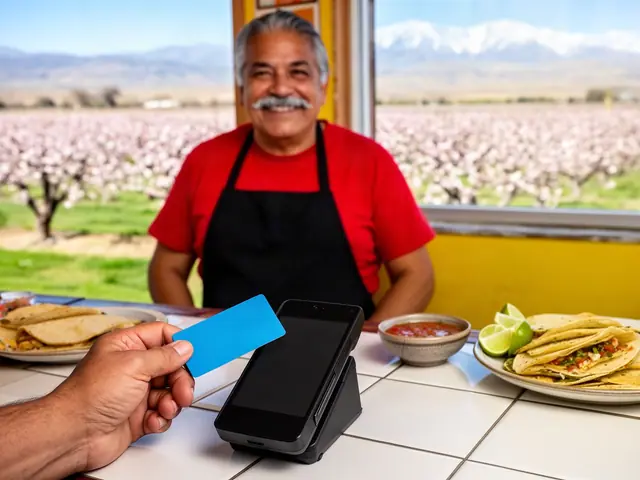
Cliffbank Lenders, a small-business funding service in Merced, California, explains merchant cash advances for Merced County restaurants and shops: how the holdback percentage works, how a factor sets the amount collected, an illustrative example, whether an advance shows on credit, and how it compares with a line of credit or a loan. An advance is not a loan; partners set its terms.
| What it is | Receipts bought in advance; no loan involved |
|---|---|
| Cost shown as | A factor such as 1.3, never an APR |
| Collected by | A holdback share of daily receipts |
| Length | Varies with sales volume |
| Partners review | Months of card settlements and deposits |
| Who decides | The funding partner |
How does a merchant cash advance work for a Merced, CA shop?
A funding partner pays you a lump sum now in exchange for a larger amount of your future receipts. That larger amount is the purchase price times a factor. The partner then collects a fixed share of your daily card sales or bank deposits, the holdback, until the agreed amount has been remitted. When sales are strong, collection runs faster; when sales dip, each day's remittance is smaller.
Is a merchant cash advance a loan, legally speaking, under its contract?
No. It is structured as a sale of future receivables, not a loan, so it carries a factor rather than an interest rate and is remitted from sales rather than repaid on a schedule. That difference matters for how cost is disclosed and what happens if sales fall. Read the agreement for reconciliation terms: whether the holdback adjusts to match actual receipts and how to ask for it.
What is a holdback percentage, in dollars per day?
The holdback is the share of each day's receipts the partner collects. Illustration only: with a 10 percent holdback and $2,600 in card sales on a Saturday, $260 is collected that day; on a $900 Tuesday, $90. Some advances instead debit a fixed daily amount from the bank account, which does not fall on slow days unless the agreement provides for reconciliation.
Merchant cash advance example
Illustration only, not an offer: a café receives $20,000 at an illustrative factor of 1.32, so $26,400 is to be collected. The cost is $6,400. With a 12 percent holdback and about $1,500 in daily card receipts, roughly $180 is collected each day, so collection would take around 147 selling days. If sales rise, it finishes sooner and the cost per day effectively rises; if sales fall, it takes longer.
Because the cost is fixed while the time varies, an advance collected quickly can carry a far higher effective cost than its factor suggests. Compare the dollar cost with what the same money would cost from a line or a short loan.
Merchant cash advance vs a line of credit
A line of credit charges interest only on what is drawn and can be repaid early to stop the cost. An advance has a fixed cost set at signing, collected from sales. For a business with steady deposits and time to wait for a review, a line is worth comparing on total cost. An advance may be considered when a line is not available or the timing is too short.
Merchant cash advance vs a business loan
A working capital loan has a principal, an interest rate and a payment schedule; prepaying usually reduces interest. An advance has a purchase price, a factor and a holdback; prepaying may not reduce the amount owed at all. Ask whether an early remittance discount exists before signing.
Stacking and reconciliation
Stacking is signing a second advance before the first one has finished collecting. Two holdbacks on the same receipts can take a large share of every day's sales, and some agreements prohibit stacking outright. Reconciliation is the process for adjusting remittances to actual receipts; know how to request it before you need it.
Merced County, CA card-heavy businesses
Accommodation and food services had 400 employer establishments in Merced County, CA in 2023, and retail trade 550 (Census Bureau, County Business Patterns). Restaurants and retail stores take daily card sales that are easy to measure, which can suit an advance's collection method. County-level counts sit on the Merced, CA figures page; the full comparison is on the comparison page; how a request works covers what partners read.
Five questions before an advance is signed
- What is the purchased amount in dollars, and what is the cost in dollars?
- Is the remittance a percentage of receipts or a fixed daily debit?
- How do I request reconciliation if sales fall?
- Does remitting early earn any discount?
- Does the agreement restrict other financing while it is open?
If any answer is unclear in writing, ask again before signing. An advance is hard to unwind once collection starts.
By Cliffbank Lenders · Updated